Sorption
Molecules are taken up from the liquid at the active-layer surface.
Process Engineering · Entry assessment
This e-learning prepares the physical membrane-separation experiment. You explain solution-diffusion transport, assess the operating influences, calculate the specific permeate mass flow and locate the central components in the P&I flow chart.
A homogeneous liquid mixture flows along a non-porous polymer membrane as the feed. Components with favourable solubility and diffusivity pass through the membrane, leave as vapour on the vacuum side and are subsequently condensed. The recirculated liquid stream is the retentate.
Qualitative direction of effect only; no linear correlation or property calculation.
What distinguishes pervaporation from a thermal-equilibrium process?
The separating layer keeps the two phases from reaching equilibrium. Transport follows solubility and diffusion in the dense polymer layer.
Which stream remains liquid in the experiment?
Feed and retentate are liquid streams. The permeate leaves the membrane as vapour.
Molecules are taken up from the liquid at the active-layer surface.
The dissolved molecules diffuse selectively through the non-porous polymer layer.
They enter the gas phase on the vacuum side.
Which sequence describes transport through the membrane?
The laboratory manual specifies these three consecutive mechanisms.
Which membrane preferentially permeates water?
The manual associates hydrophilic membranes with preferential water transport and organophilic membranes with preferential transport of organic material.
Which change reduces the permeate flow according to the manual?
Permeate flow increases as membrane thickness decreases, so a greater thickness has the opposite effect.
Why is the membrane conditioned before a new material system?
Gradual adaptation prevents damage and creates reproducible steady conditions.
The collected permeate mass is related to membrane area and measuring time:
According to the P&I data block, the installed cross-flow membrane has an area of 201 cm² = 0.0201 m².
Calculate the specific permeate mass flow.
Which instrument is used to determine mixture composition?
The thermostatted refractometer provides the refractive index used to determine composition.
Match each tag to its main function.
Hold the tempered feed
Thermostat the feed vessel
Circulate the liquid
Separate the mixture selectively
Condense the permeate
Temperature-control the condensation system
Collect permeate volumetrically
Generate permeate-side vacuum
B1 · tempered feed vessel · B2 · laboratory thermostat for B1 · P1 · micro gear pump · F1 · cross-flow membrane module · W1 · permeate condenser · B3 · low-temperature cooling thermostat · X1 · tempered measuring burette · P2 · diaphragm vacuum pump
Locate the requested function in the original flow chart. The question deliberately omits the name and tag. The sequence is reshuffled on every page load.
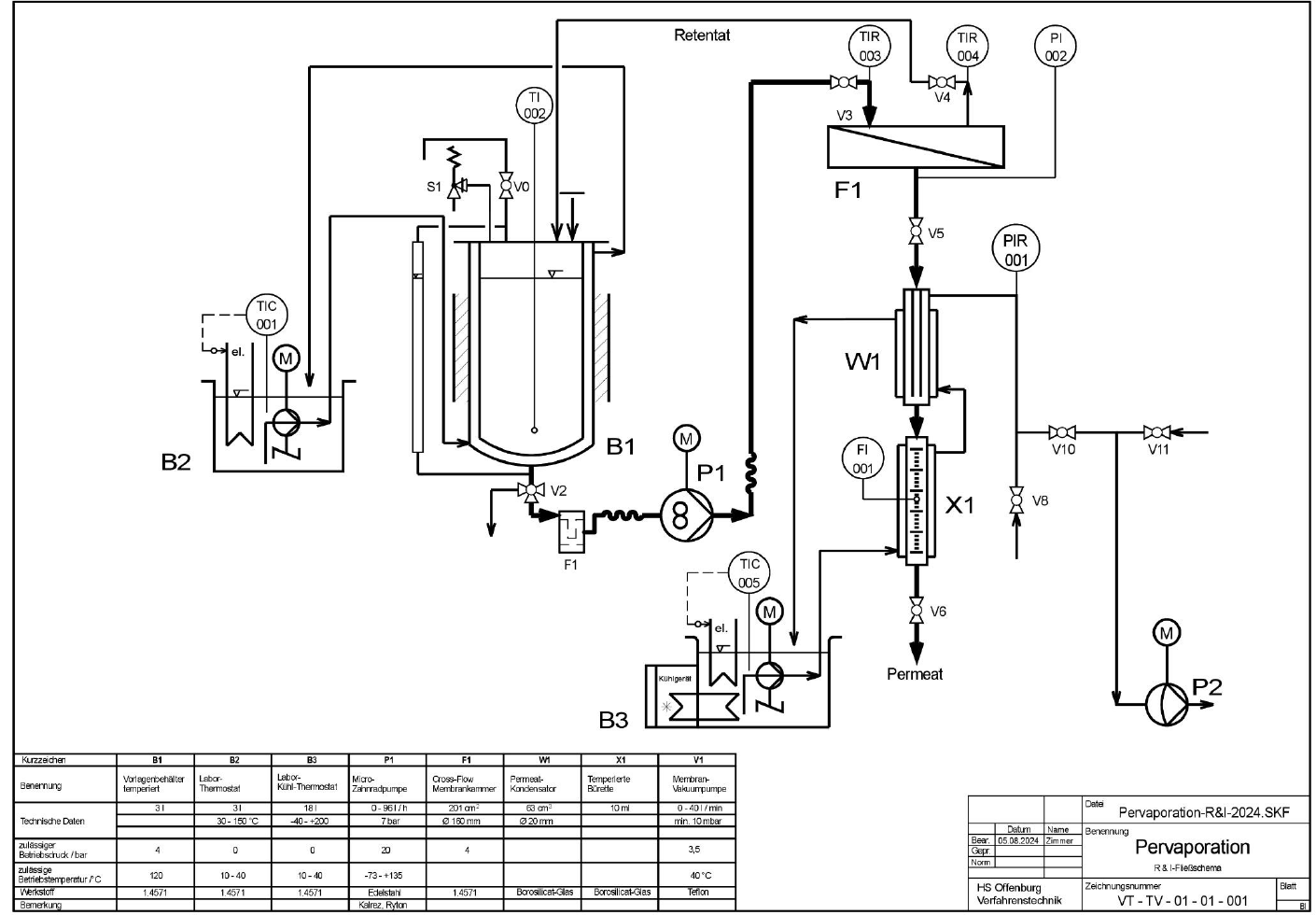
Laboratory staff fill the mixture, condition the membrane and set the feed flow and low-temperature thermostat. Each group determines permeate flux at two temperatures between 65 °C and 90 °C; V11 sets an absolute pressure of 15 mbar or 30 mbar. Tag discrepancy in the original source: Section 4.1 names PIR 003, while the P&I flow chart on page 7 labels the vacuum-pressure instrument PIR 001.
Which valve sets the pressure referred to as PIR 003 in Section 4.1?
V11 sets an absolute pressure of 15 mbar or 30 mbar. In the P&I flow chart, the associated vacuum-pressure instrument is labelled PIR 001.
The verifiable PDF is enabled only after all six modules have been passed. It contains the completion status and the answers that were actually checked.
| Module | Status |
|---|---|
| 01 · Principle | Open |
| 02 · Membrane transport | Open |
| 03 · Influences | Open |
| 04 · Permeate flux | Open |
| 05 · Plant | Open |
| 06 · R&I-dry run | Open |
Still locked: complete all six modules first.